Water damage? Don't wait.
Call (855) 529-0071 — 24/7 emergency help across 17 states. Free inspection, written scope.
Blog
Home » Blog » Mold After Water Damage: How Fast It Grows & Removal
You fixed the leak. The floors look dry. The crisis feels over — and then, two weeks later, you notice a musty smell in the hallway, or dark spots creeping along the baseboard. Mold after water damage is the second disaster hiding inside the first one. Mold doesn't need much: moisture, organic food (drywall, wood, dust), and a little time. This guide explains exactly how fast mold grows after water exposure, where it hides, the health risks it creates, how professional removal works, what it costs, and — most importantly — how to stop it before it starts.
The timeline is faster than most homeowners expect:
Temperature and humidity are accelerators. Mold thrives between 77°F and 86°F with relative humidity above 60%. A water-damaged home in Arizona in winter dries faster and grows mold slower than the same damage in coastal Georgia in summer — but given enough moisture, mold grows anywhere, including in cold climates.
The critical insight: if materials stay wet for more than 48 hours, assume mold is developing — even if you can't see it yet. Mold inside wall cavities and under flooring is invisible from the room. This is why professional water damage response emphasizes extraction and structural drying within the first day or two: it's not just about the water, it's about beating the mold clock.
Visible mold on a wall is the tip of the iceberg. After a water event, mold colonizes the places you don't look:
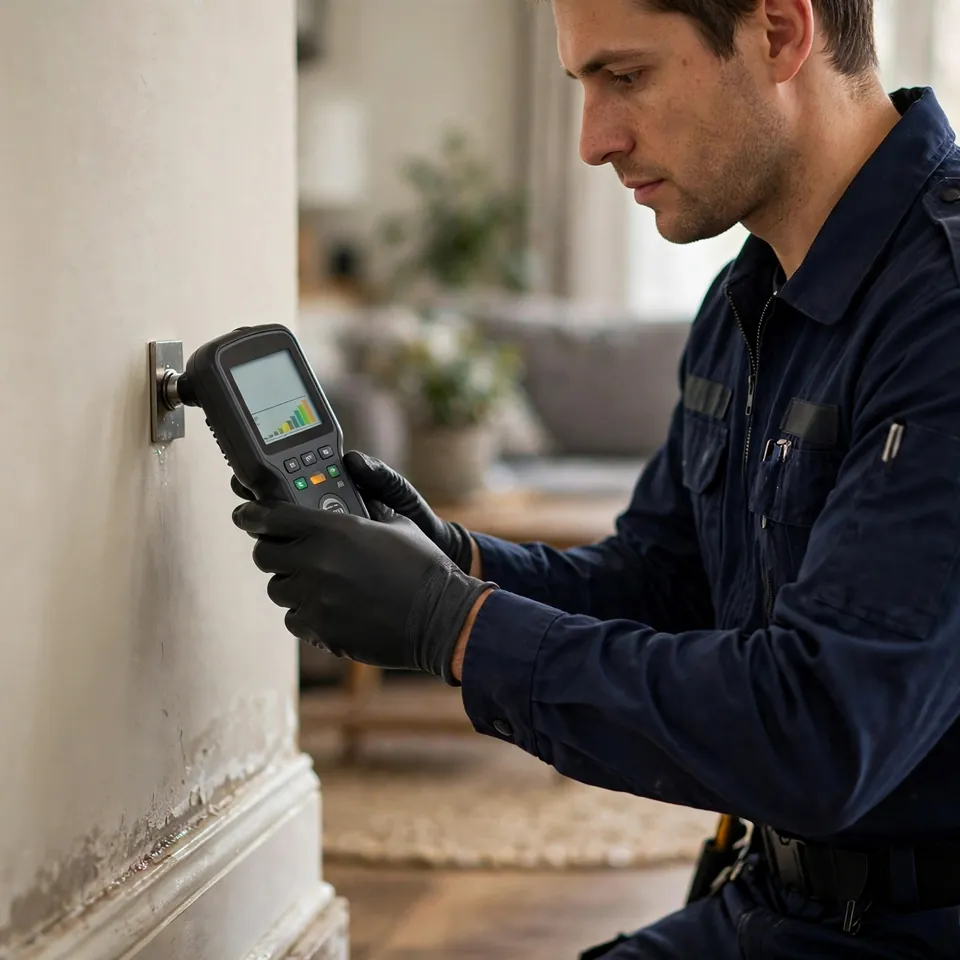
This is why a moisture meter survey matters more than a visual check. Professionals map moisture inside materials, not just on surfaces, and open up suspect cavities rather than assuming they're fine.
Not everyone reacts to mold the same way, but the health effects are well documented:
Children, elderly people, pregnant women, and anyone with asthma, allergies, or a compromised immune system are most vulnerable. If anyone in the household develops new or worsening respiratory symptoms after a water event, take it seriously — and get the moisture and mold addressed, not just the symptoms.
One important note: the color of mold tells you nothing about its danger. Black mold isn't automatically toxic, and white or green mold isn't automatically harmless. Only lab testing identifies species, and species alone doesn't determine the health risk — the extent of growth and individual sensitivity matter more. Don't let anyone scare you (or reassure you) based on color alone.
When mold has established itself after water damage, cleanup becomes mold remediation — a controlled process designed to remove mold without spreading it:
1. Inspection and moisture source identification. The crew locates all mold growth — visible and hidden — and identifies the moisture source that fed it. Remediating mold without fixing the moisture source is pointless; it'll grow back. If the original water event was never properly dried, that gets addressed first.
2. Containment. The work area is sealed with plastic sheeting, and negative air pressure is established with HEPA-filtered air scrubbers. This prevents spores from spreading to clean areas during the work — critical, because disturbing mold releases massive quantities of spores.
3. Air filtration. HEPA air scrubbers run continuously during remediation, capturing airborne spores. In severe cases, the crew may also treat the HVAC system to prevent redistribution.
4. Removal of contaminated materials. Porous materials with heavy mold growth — drywall, insulation, carpet, ceiling tiles — are removed, bagged, and discarded. There's no cleaning mold out of porous drywall; the paper facing is food all the way through. Semi-porous materials like wood framing can often be saved with HEPA vacuuming, wire brushing or sanding, and antimicrobial treatment.
5. Cleaning and disinfection. All remaining surfaces in the contained area are HEPA-vacuumed and wiped with antimicrobial solutions. This includes studs, subfloors, and any salvageable materials.
6. Drying verification. Moisture readings confirm everything is dry before rebuild. Rebuilding over damp framing restarts the whole cycle.
7. Post-remediation verification. In significant jobs, an independent third-party inspector (not the remediation company) verifies the work: visual inspection, moisture readings, and sometimes air sampling comparing indoor spore counts to outdoor baselines. This independent clearance is the gold standard — ask for it on any large remediation.
| Remediation Scope | Typical Cost Range | Common Scenario |
|---|---|---|
| Small isolated area (<10 sq ft) | $500 – $1,500 | Bathroom wall section, under-sink cabinet |
| Medium area (10–100 sq ft) | $1,500 – $4,000 | Wall cavity mold after a pipe leak, closet wall |
| Large area (100+ sq ft) | $4,000 – $10,000 | Multiple rooms, basement wall systems |
| Whole-house / severe contamination | $10,000 – $30,000+ | Flood aftermath, long-term hidden leaks, HVAC involvement |
| Independent post-remediation testing | $300 – $800 | Third-party clearance inspection and air sampling |
Costs scale with containment complexity, the amount of material requiring removal, and whether the HVAC system is involved. The original water damage repair (drying, reconstruction) is a separate cost on top of remediation — which is exactly why preventing mold through fast water response is so much cheaper than remediating it later.
Insurance note: Mold coverage is tricky. Most homeowners policies cover mold remediation when it results from a covered water event (like a burst pipe) — but many cap mold coverage at $1,000 to $10,000, and some exclude mold entirely. Long-term leaks and neglected maintenance are almost never covered. Read your policy's mold provisions before you need them.
Every mold problem after water damage traces back to moisture that wasn't removed fast enough or completely enough. Prevention is straightforward:
Small surface mold — less than about 10 square feet on a hard, non-porous surface like tile or glass, with no water damage behind it — can be a DIY job: scrub with detergent, dry completely, fix the moisture source. The EPA's guideline of 10 square feet is a reasonable threshold.
Call professionals when: the mold covers a larger area, it's on porous materials (drywall, wood, carpet), it's inside wall cavities or HVAC systems, it resulted from sewage or floodwater contamination, anyone in the household has health vulnerabilities, or it keeps coming back after cleaning. Recurring mold is always a sign of an unresolved moisture problem — and finding that problem is detective work that benefits from professional moisture mapping.
One DIY warning: don't just spray bleach on mold and call it done. Bleach kills surface mold on non-porous materials but doesn't penetrate porous ones — the roots survive in drywall and wood, and the water in the bleach solution can actually feed regrowth. Worse, it gives a false sense of resolution while the colony continues behind the surface.
Good to know
Mold begins germinating within 24 to 48 hours on damp organic materials like drywall and wood. Visible growth typically appears within 3 to 7 days, and established colonies spread through wall cavities within weeks. Warm, humid conditions accelerate the timeline. The practical rule: if materials stay wet beyond 48 hours, assume mold is developing even if you can't see it.
Yes — and it frequently does. Water wicks up inside wall cavities, soaking insulation and the back of drywall where mold grows in the dark. Signs of hidden mold include musty odors, unexplained allergy symptoms, discoloration at baseboards, and moisture meter readings that stay elevated. Professionals find it with moisture meters, thermal imaging, and small inspection openings rather than guesswork.
Not necessarily. Color doesn't indicate toxicity — black-colored molds include both harmless species and Stachybotrys chartarum, which can produce mycotoxins under certain conditions. Conversely, many light-colored molds trigger strong allergic and asthmatic reactions. What matters more than color or species is the extent of growth, the duration of exposure, and individual sensitivity. Any significant indoor mold growth deserves professional assessment regardless of color.
Drying stops active growth, but it doesn't remove the mold that's already there — dormant mold remains allergenic, and it reactivates the next time moisture returns. Dead mold still triggers allergies and asthma. Proper remediation removes the contamination; drying alone only pauses it. This is why post-water-damage cleanup includes both thorough drying and inspection for growth that started during the wet period.
Sometimes, with limits. Most policies cover mold remediation when it stems from a covered sudden event (burst pipe, appliance failure) but cap the payout — commonly $1,000 to $10,000 — and many policies now carry explicit mold sublimits or exclusions. Mold from long-term leaks, flooding (without flood insurance), or neglected maintenance is typically excluded. Check your policy's mold language now, before you need it.
For significant jobs, hire an independent third-party inspector for post-remediation verification — visual inspection, moisture readings, and air or surface sampling compared against outdoor baselines. The remediation company verifying its own work is a conflict of interest. Also trust your senses over the following weeks: no musty odor, no returning discoloration, and no recurring symptoms are the real-world confirmation. Mold after water damage is predictable, preventable, and fixable — but the window for the cheap fix (fast drying) closes within 48 hours, and every day after that the expensive fix (remediation) gets more expensive. If you've had any water event in your home — a leak, a flood, a backup, even a minor overflow that "dried on its own" — it's worth having the moisture checked before mold makes the decision for you. Call **Water Damage Cleanup Now** at **(855) 529-0071** for fast water extraction, thorough structural drying, and professional mold remediation that solves the problem at its source.
Call (855) 529-0071 — 24/7 emergency help across 17 states. Free inspection, written scope.